

Understand platform commitments
Licence terms, infrastructure and integration dependencies shape the migration case. Savings must be calculated, not assumed.
Nexus has been used on an Ingenium system. Echelon and Vista are implemented in part and undergoing qualification; Aira is still in design. BENOVA is an intended application, not a deployed modernization reference.
Contact us by emailFor insurers running Ingenium · COBOL · AIX · IBM MQ
Keep the business knowledge in your core while evaluating a gradual path to new services. BENOVA brings process orchestration, human review and planned AI assistance together with Ingenium-focused tools.
Continuity, deployment options and licence impact must be assessed for each environment.
The problem
Modernization starts with your constraints, not a verdict on COBOL. Identify where platform dependencies, concentrated knowledge and manual handoffs limit the changes your business needs.
Licence terms, infrastructure and integration dependencies shape the migration case. Savings must be calculated, not assumed.
When operational knowledge sits with a few people, routine changes become harder to review and repeat. Documented procedures matter more than a language trend.
Builds, releases and integration work can involve many manual steps. Measure the actual bottleneck before choosing what to automate.
Differences between development, testing and production can hide defects. Repeatable checks help teams find drift before a release.
A staged approach limits the scope of each change. It still needs reconciliation, recovery planning and operational acceptance.
Core ecosystem
EVA combines Echelon, Vista and Aira for process work; Base connects applications to COBOL workers, Nexus supports Ingenium operations, and Orbit is a hybrid service-host direction. Each product has a distinct purpose and readiness level; qualify it for the target environment before adoption.
Orchestration framework
A Rust orchestration backend for work spanning people and services, with AI participation planned. SPINE defines the semantics, Basal holds workflow and navigation authority, and Echelon hosts and persists execution. BENOVA is an intended first application, not evidence of a deployed core migration.
Defines the meaning of Flow, Process, Task and Outcome independently of the user interface. It is the semantic core within Echelon.
Owns workflow decisions and navigation. Neither the user interface nor an AI assistant decides independently how a Process advances.
Handles built-in process work. Business services and human judgment remain separate responsibilities.
Neither is implemented, and their contracts are not settled. Scheduling and deadline handling must not be assumed available.
COBOL worker connectivity and operations
Combines BineanGateway, iman and ingipc to connect applications to Ingenium workers, manage pools and bound execution without requiring a business-logic rewrite first.
DevOps for Ingenium
A DevOps toolchain built specifically for Ingenium, running inside VS Code. It turns risky manual operations into standardized, repeatable pipelines.
Hybrid service host
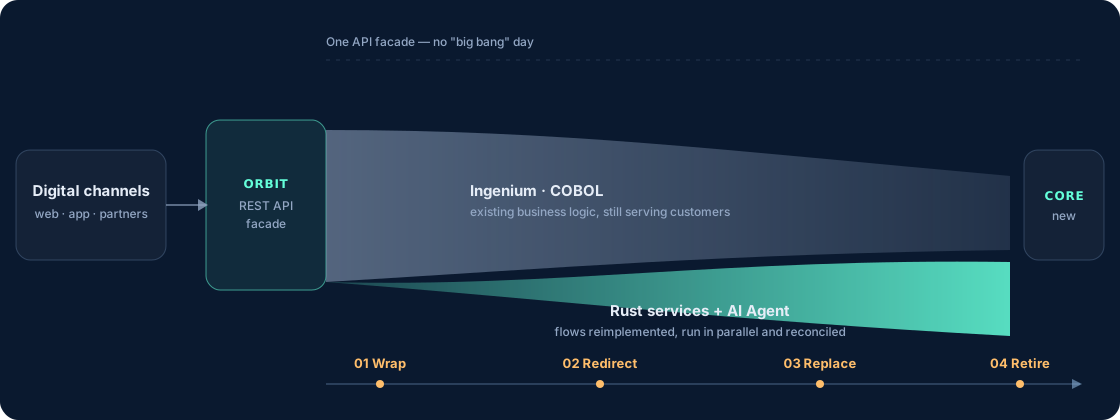
Orbit is being developed as a hybrid service host: a way to connect Ingenium and new services behind an API facade. Each integration needs its own validation before traffic is moved.
Flow & task management
The human workbench in EVA. Vista presents state, collects input and calls backend contracts; it does not own business or workflow decisions. The Process workspace is still being completed.
Artificial intelligence
Aira is the planned AI layer of EVA, not a shipping agent. It is planned as a local service a person starts, acting with that person's own identity: owning an AI Task, or preparing a draft the person reviews and submits.
How you adopt it
The proposed Strangler Fig path separates modernization into qualified slices. Compare results and operational behavior before expanding. Neither uninterrupted service nor rollback is guaranteed by the pattern alone.
Map Ingenium interfaces and dependencies, then qualify an Orbit integration boundary.
Define which work stays on Ingenium and which may move. Validate routing and authorization before cutover.
Implement selected work in services; consider AI only after its role and acceptance criteria are validated. Reconcile against agreed business outcomes.
Retire a legacy path only after operational acceptance, data reconciliation and licence review. Recovery options depend on the changes already made.
Benefits
Set a baseline and acceptance criteria for each pilot. A technical change creates an opportunity; evidence determines whether it delivers value.
Answers: Understand platform commitments
Compare licences, infrastructure, migration and support costs. Removing a middleware dependency is an integration decision, not an automatic saving.
Answers: Make specialist knowledge accessible
Use Nexus procedures to reduce reliance on undocumented steps. Specialist review remains essential for business behavior and release decisions.
Answers: Reduce delivery friction
Evaluate build and operational automation against your current workflow. API integration still requires compatible interfaces and testing.
Answers: Make environment differences visible
Use environment comparisons and repeatable procedures to expose differences. These controls reduce uncertainty; they do not eliminate defects or establish compliance.
Deployment on private infrastructure is a target profile, not a compliance guarantee. Data controls, licensing and operational responsibilities need agreement for each deployment.
Nexus is the available starting point for Ingenium operations. For EVA and Orbit, discuss a qualification pilot with clear scope and an accountable owner—not a commitment to a production migration.
Email only, no commitment. We will be straight about what works today and what does not.